
Two babies, one body doing the work. That’s really why a twin pregnancy gets filed as high-risk, the odds of complications go up for both mother and babies compared to carrying one. Some of the early tells, sharper nausea, weight climbing faster than expected, a uterus measuring ahead of the dates, are often what nudges a doctor to check for twins before the routine dating scan even happens. Once it’s confirmed, monitoring changes shape entirely. Twins simply mean more to track. That doesn’t guarantee trouble. It just shrinks the room for anything to slip past unnoticed.
According to Dr. Reshma K Priya of Rahat Hospital, one of the best maternity hospital in bhubaneswar, “A twin pregnancy isn’t automatically a difficult one, but it does need closer watching. Preterm labor, gestational diabetes, and preeclampsia all show up more often with twins, so we schedule scans more frequently right from the start rather than waiting for a problem to surface.”
What Are the Risks of a Twin Pregnancy Across Each Trimester?
Complications in twin pregnancy don’t sit still. They shift shape as the pregnancy moves from one trimester into the next.
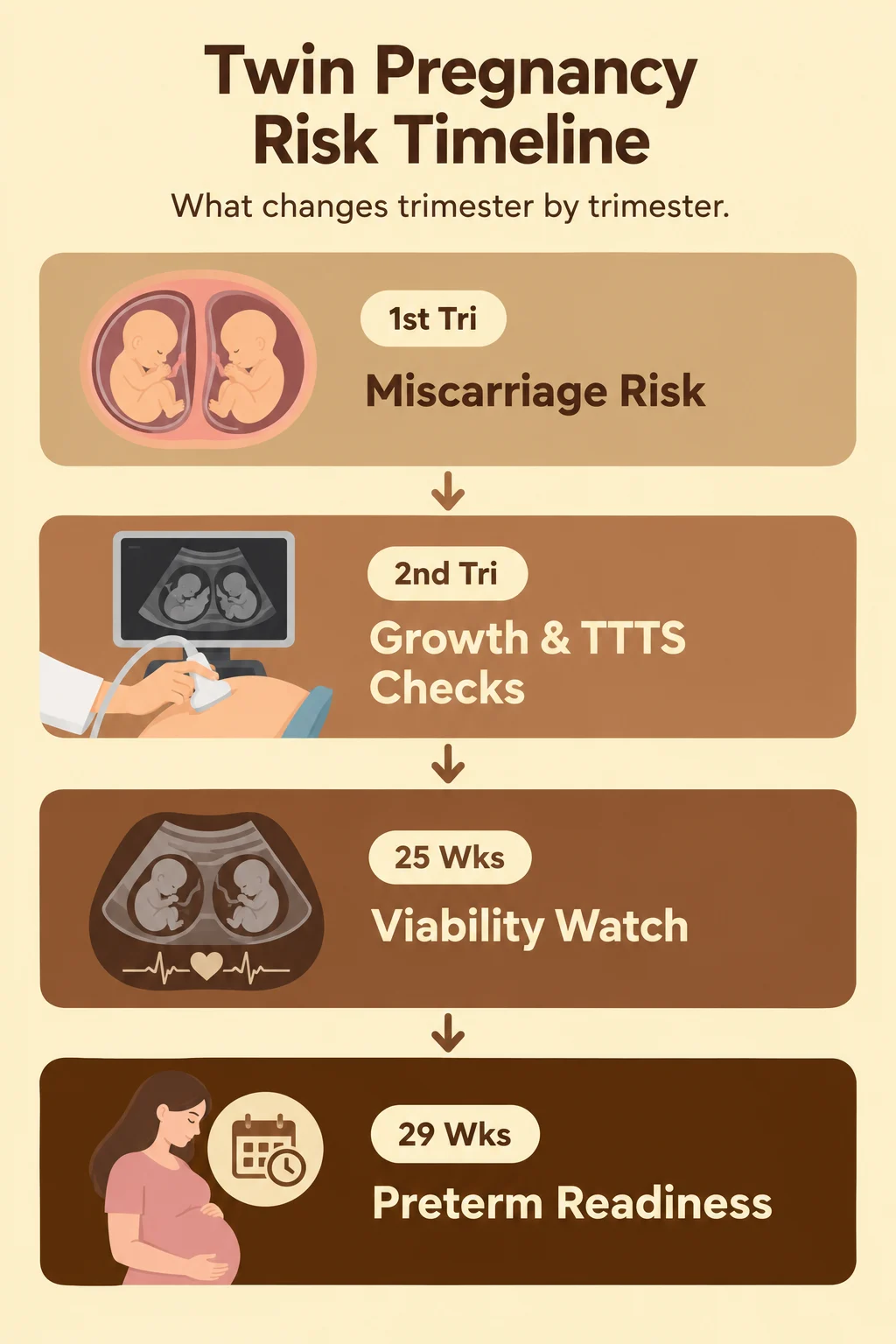
Each stage on this timeline calls for a different kind of watching, not just more visits, but different tests at different points. Chorionicity gets settled early since it decides how closely a set of twins needs following for the rest of the pregnancy. Later on, cervical length and growth comparisons between the two babies carry more weight than they would in a single pregnancy, simply because twins share less room to compensate for a slow start. None of this is about assuming something will go wrong. It’s about catching it early enough that it usually doesn’t have to.
This kind of trimester-by-trimester tracking is exactly what high-risk pregnancy monitoring at Rahat Hospital is built around.
Expecting twins and unsure what extra monitoring you’ll need?
How Does a Twin Pregnancy Compare to a Singleton, and What Precautions Help?
Discharge isn’t set by a date on a calendar. It comes down to a specific set of milestones the baby has to clear first.
|
Factor |
Singleton Pregnancy |
Twin Pregnancy |
|
Average delivery timing |
Around 39-40 weeks |
Often before 36 weeks |
|
Gestational diabetes risk |
Baseline risk |
Roughly double the baseline |
|
Preeclampsia risk |
Baseline risk |
Significantly higher |
|
Anemia risk |
Baseline risk |
Higher, due to increased iron demand |
- More frequent antenatal visits: Scans booked every two to four weeks, tighter than a singleton schedule, catch a growth mismatch or fluid imbalance while it’s still minor.
- Iron and nutrition adjustments: Higher iron and folate needs tend to come with twin pregnancy regardless of the mother’s age, so supplementing usually starts sooner and at a stronger dose.
- Watching for preterm labor signs: Contractions on a pattern, pelvic pressure, lower back pain ahead of 37 weeks, none of it should sit and wait. Twins simply arrive early more often.
- Managing activity and rest: Long stretches on your feet, or heavier activity late in the third trimester, can increase pelvic pressure and fatigue more quickly with twins. Slowing down sooner tends to help.
Since preeclampsia risk climbs noticeably with twins, it’s worth reading our detailed breakdown on preeclampsia warning signs by trimester alongside this one.
Why Choose Rahat Hospital ?
Rahat Hospital is a women and child care centre in Saheed Nagar, Bhubaneswar, and twin pregnancies here get treated as a defined high-risk category from day one, not folded into standard prenatal care. Dr. Reshma K Priya, founder and chief gynaecologist, has managed multiple pregnancy cases across more than a decade of clinical practice, including chorionicity-specific monitoring for twins who share a placenta. Scans every two to four weeks are the default here for twin pregnancies. And because the hospital runs its own Level III NICU on-site, a preterm twin delivery never means transferring either baby to another facility for care.
FAQs
What tends to show up first with a twin pregnancy?
Nausea that hits harder, weight climbing faster, and a uterus running ahead of schedule are usually the first signs.
Which complication comes up most often with twins?
Preterm labor, by a fair margin, most twin pregnancies are likely to end before 37 weeks.
Does age change the risk profile for a twin pregnancy?
It does. Conceiving twins naturally and running into complications both become more likely past 35.
Do twin pregnancy symptoms actually feel different from a singleton's?
Yes, they tend to show up sooner and hit with more force, particularly the nausea, exhaustion, and weight gain.
Disclaimer: This blog is for general information only and isn’t a substitute for professional medical advice; please consult a qualified doctor for diagnosis and treatment.
